Damien Soitout
Where the money sits is the risk. After a bank can close, "at the bank" is not a place. Name the seat, for a home or a company.
A vault door is a picture. The risk is the seat the money actually has.
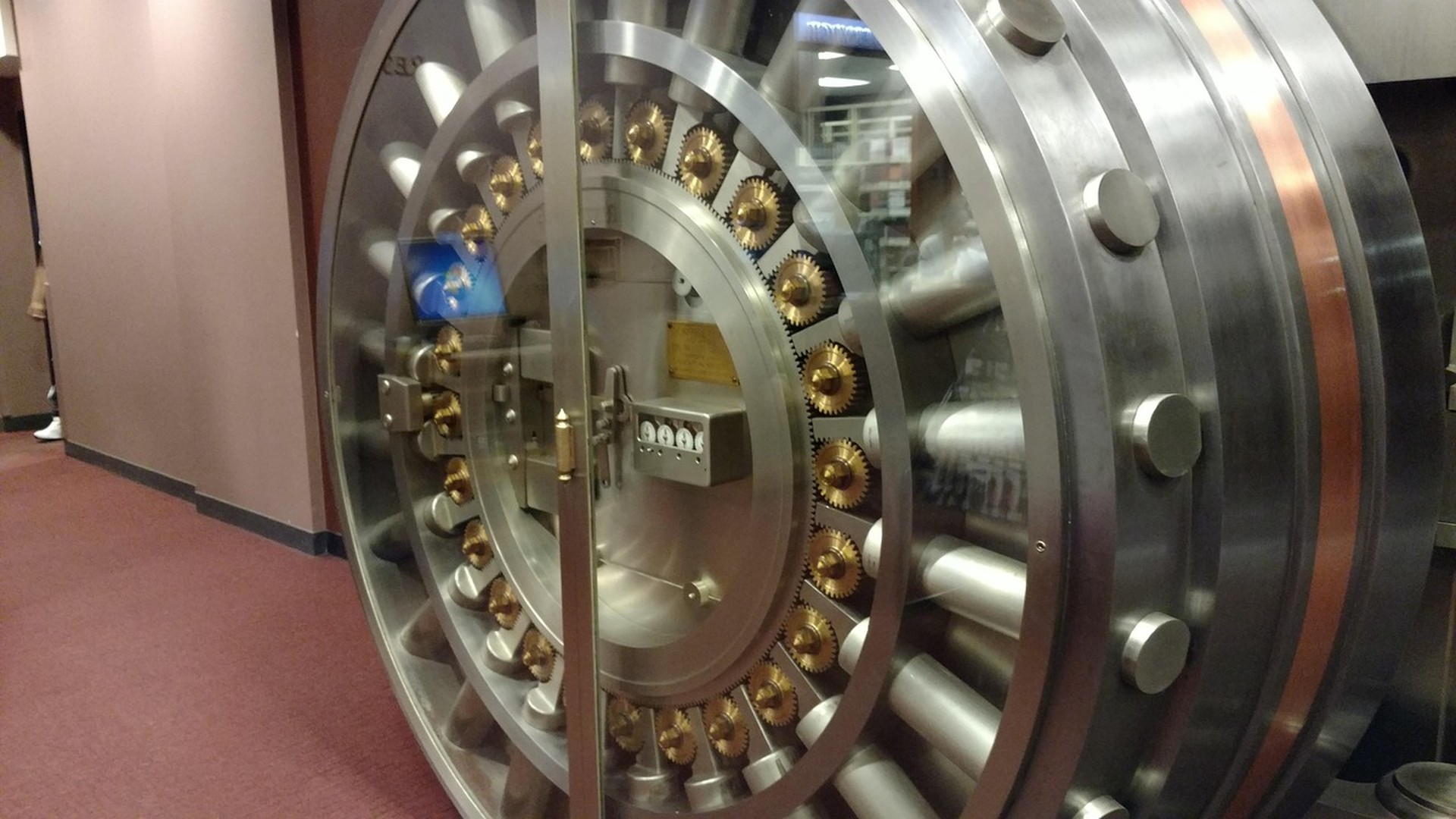
Where the money sits is the risk. The phrase sounds blunt because the softer phrase has just failed a public test. For years, “at the bank” worked as a period at the end of a worry. The money was somewhere with a name, so the worry was supposed to sit down. A Friday closure, the one I described as a bank can close on a Friday, takes that period away. It does not take away the need for a place to hold money. It takes away the right to treat the place as too obvious to name. The vault door in the picture is open beside a corridor. It is a photograph of a door. It is not a proof that anyone's money has a seat.
This is a cash question for a household and for a company, three weeks after that Friday, on 10 April 2023. The question is the same size in both places even when the amounts are not. What job is the money doing, and in what seat is that job sitting? A seat has a legal name, a kind of claim, and a rule about what happens if the institution stops. “At the bank” has a mood. The mood is that someone serious is watching, so you do not have to. Sometimes the mood matches a real rule. Often it is doing extra work. It covers a payment app, a brokerage cash balance, a customer's uncashed invoice, and the login everyone shares because it was faster. Those are not one place. Calling them one place is how a risk hides.
The failure mode changes with the seat. Money that is a deposit in a bank fails in one way. Money that is cash and securities at a brokerage fails in another. Money that is a promise from a customer fails in a third. Money that is only a number in a budget you have not matched to a real account has not failed yet, because it was never sitting anywhere. It was a sentence. Name the job before you name the fear. Paying wages is a job. Receiving what customers owe is a job. Holding a tax set-aside is a job. Holding a reserve you do not plan to touch this month is a job. Each job can sit in a different seat, or in the same seat by habit. The habit is the thing to see. Convenience piles jobs into one login. One login is a single point of failure even when every dollar inside it is, on paper, ordinary.
A higher price of money, the change in what borrowing costs, does not make one seat clever. It can tempt a person to move a reserve toward whatever is advertised as paying more, and to stop asking what the new seat is. The advertisement is not a description. A company and a household meet here. You can do the naming on a page of your own before anyone performs it at a dinner table. A money talk at home that is not a lecture is a later skill. The list can happen now, quietly. Price a life change before you invent the budget is the cousin of this list: write the costs you can point at, and do not decorate them. A feeling of safety borrowed from a vault door is still a feeling.
The Federal Deposit Insurance Corporation explains deposit insurance on its page Understanding deposit insurance. The insurance protects money in deposit accounts at FDIC-insured banks if that bank fails. Coverage is at least 250,000 dollars per depositor, per ownership category, at each insured bank. Checking accounts, savings accounts, money market deposit accounts, and certificates of deposit are the kind of thing it covers. Stocks, bonds, mutual funds, annuities, the contents of a safe deposit box, and crypto assets are on the list of what it does not cover, even when a bank offered them. Deposits in the same ownership category at the same bank are added together. A different bank, or a different ownership category, is a different calculation. The FDIC's point, which I want in ordinary language, is that “insured” is a rule with a shape. It is not a mood that spreads to every product sold in the same building.
The Securities Investor Protection Corporation explains a different rule, for a different seat, on what SIPC protects. SIPC protects against the loss of cash and securities, such as stocks and bonds, held by a customer at a financially troubled brokerage firm that is a SIPC member. The limit it states is 500,000 dollars, which includes a 250,000 dollar limit for cash. Protection is about the custody function. In a liquidation, SIPC works to restore the cash and securities that were in the account, and it can replace missing securities when that is possible. It does not protect you against a decline in the value of those securities. It does not protect you against worthless stocks, bad advice, or an unsuitable recommendation. Cash held for a commodities trade is outside it. A money market mutual fund is protected as a security, not as a bank deposit. SIPC says the protection is not the same as FDIC insurance, because SIPC does not protect the value of a security. A non-U.S. customer at a member firm is treated, on that page, the same as a U.S. customer. The passport is not the seat. The membership of the firm, and the custody of the asset, are the seat.
Read those two pages as a pair and the phrase “at the bank” falls apart. A deposit is a claim on a bank, inside categories a statute defines, up to a figure the FDIC publishes. A brokerage account is a custody relationship with a broker, inside a different statute, up to a figure SIPC publishes, and the market value is your risk either way. A payment app may be neither, until you have read which bank, if any, actually holds the balance. An invoice a customer has not paid is not in any of those systems. It sits with the customer. What a broker is is the piece to read before you let a login with a broker's logo inherit the feeling you used to reserve for a deposit. The logo is marketing. The statute is the seat.
The FDIC's record of Silicon Valley Bank is still the public object for that Friday. The bank in Santa Clara was closed on 10 March 2023. No advance notice is given to the public when an institution is closed. Depositors were protected in that resolution by a specific action that weekend, including depositors above the ordinary insurance limit. On 26 March the FDIC entered a purchase and assumption with First-Citizens Bank and Trust Company, of Raleigh, for the deposits, excluding Cede and Co. deposits, and the loans of the bridge bank. The record says transferred deposits are separately insured from accounts a person might already have had at the assuming bank, for at least six months after the failure. Those sentences are about that receivership. They are not a new meaning of “at the bank” for every household in every country.
The useful distinction is the one people skip. An ordinary insured deposit has a published limit and a category. A resolution can, in a named case, protect depositors beyond that limit because the authorities decide the case requires it. The decision is not a product you can buy, and it is not a feature of your login because you saw it on the news. Shareholders were not depositors. A general creditor was not a depositor. If your money is not a deposit, the March action was never about you. If your money is a deposit, the ordinary rule is still the rule you can read on the FDIC's insurance page, and the extraordinary action is a fact about two banks in one weekend. Where the money sits is the risk because you have to know which of those sentences is yours. Guessing that “they protected everyone” is how concentration comes back, wearing the story of the rescue as a new kind of shrug.
If this is your money, write the seats on one page. Which job sits where. Which rule covers that seat. Which login holds more than one job. The vault door is a picture. The risk is the seat the money actually has. Name it.