
Damien Soitout
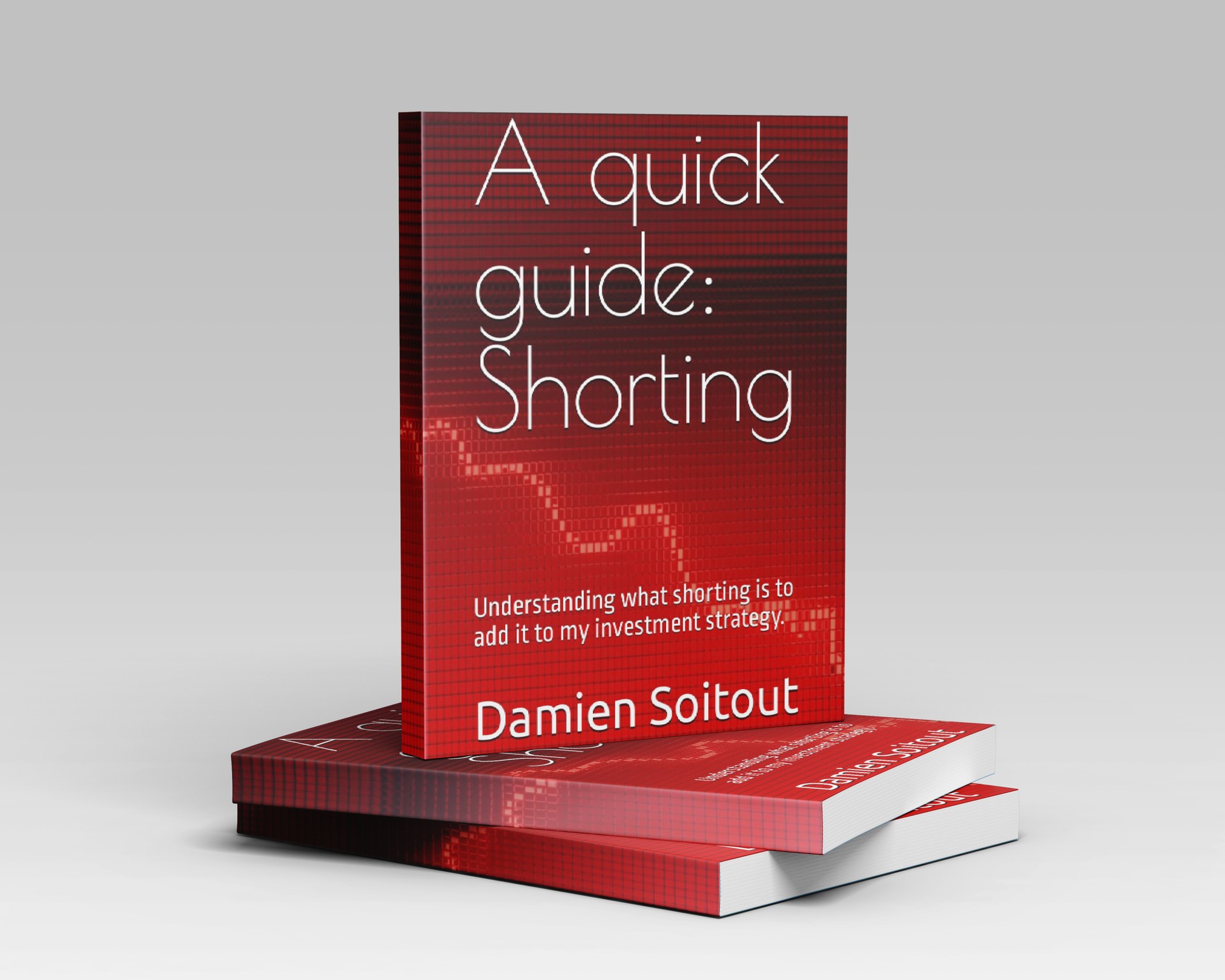
What shorting is, and what it is not: a short sale borrows a security, sells it, and must buy it back, with no promised result.
Volume one of A Quick Guide. The book explains a tool. It does not hand you an outcome.
On 11 January 2024 I published the Kindle of the first quick guide, A Quick Guide: Shorting. The English shop pages for the paperback and the Kindle followed on 23 and 25 January, so as of today, 26 January, you can hold the object: the paperback and the Kindle. The same book is out in French and in Spanish, on paper and on Kindle. The Amazon page for the English Kindle is here. I wrote it as an introduction a general reader can finish, not as a signal, and not as a result. What shorting is, and what it is not, is the whole job of the book. People mythologize the word. They hear it as a trick used by people who know something the public does not, or as a way to get paid for a collapse. The word is plainer than the myth, and the plain version is more dangerous, not less, because the danger is in the shape of the trade.
A long position is the one most people already understand. You buy something you think is cheap. If the price rises, you can sell higher. If the price falls, you lose, and the most you can lose on a simple purchase of shares is what you paid, because a price does not go below zero. Shorting inverts that. You sell first, and you sell something you borrowed. You are counting on being able to buy it back cheaper, return what you borrowed, and keep the difference after costs. If you are wrong, and the price rises, you still have to buy it back. There is no zero waiting above you to stop the price. That is the fact I want a reader to have before any story about courage or villainy.
The same January also put 100 Horas, the Spanish edition of 100 Hours, into the world. The Kindle is 15 January, and the Spanish shop pages are 23 January. That book is not this book. It is a set of tools for a life, not an explanation of a market position. Reading 100 Hours in Spanish is the essay for that edition, and it belongs in April, as a reading, not as a second launch crowded into this week. If you want the Spanish object now, it is on the shelf: the Kindle and the paperback. Then come back. Shorting is a different tool, and mixing them is how both get used badly.
In the book I define short selling as the sale of borrowed assets, made because you expect the market value to fall. You borrow a quantity, often of shares, usually through a margin account where you post collateral. You sell those borrowed assets in the open market. You wait. If the price falls, you buy the same quantity back, you return what you borrowed, and the gap between the sale and the purchase, after fees and the cost of the borrow, is the result of that one position. The U.S. Securities and Exchange Commission keeps a public glossary entry for this on Investor.gov. Read it beside the book. A glossary is the public shape of the word. The book is the walk through the risks, the arguments, and the ways the word gets misused.
Five parties sit around that shape, even when a phone app hides them. The lender owns the shares and is willing to lend them. The borrower is you, if you are the one who sold. The market is everyone else buying and selling. A broker and a clearing house stand between, because the borrow, the sale, and the later return have to match. A regulator watches the rules of the place where this happens. If any of those is missing from your picture, you have a cartoon. The cartoon is how people come to believe a short is a button. It is a chain of obligations. The last obligation is the return of what you borrowed, at whatever the price is when you are forced, or when you choose, to close.
The borrow is not free. You pay for it, and the shares you want most, the ones many people already want to short, are often the expensive ones to borrow, or the ones you cannot borrow at all. Collateral can be raised if the price moves against you. That call does not wait until you feel ready. I wrote the mechanism in ordinary steps so a reader who will never place the trade can still see why a person who does place it is not holding a calm bet. They are holding a position that can demand more money while it is open. Ideas for investing from a young age belong to a different conversation, the long one, the one where time is on the side of a purchase you can leave alone. A short is not that conversation. Do not file it there because both subjects use the word money.
It is not a promise. Nothing in the guide, and nothing on this page, tells you that a price will fall, or that a falling price will pay you. The book is full of cases where the person who was sure got hurt. Volkswagen in 2008, when a rush to buy shares back crushed people who were short. Tesla's rise in 2020, which punished a crowded bearish view. GameStop in 2021, which became a public lesson in how fast a short can be forced to buy. Herbalife, argued over for years. Lehman, where being directionally right about a firm was not the same as being safe in the position. I put those in the book as scars, not as a menu. A scar shows you the shape of the loss. It does not hand you the next winner.
It is not market manipulation, and the confusion between the two is the misconception I spend time on. Manipulation is an attempt to push a price into a false appearance. A legitimate short is a sale of something you borrowed, grounded in a view that the asset is expensive, done inside the rules of the market you are in. Critics mix them because both can involve a falling price, and a falling price hurts employees and holders. The hurt is real. It does not turn every short into a fraud, and it does not turn every fraud accusation into an analysis. If you cannot say which one you mean, you are not ready to use the word in either direction.
It is not a small, capped risk that happens to point downward. The loss on a simple long purchase is capped by what you paid. The loss on a short is not capped by the instrument itself, because the price you must pay to close can keep rising. You can use stops, size, and diversification to limit what you are willing to lose, and the book walks through those as risk tools, not as magic. A stop can be jumped over when a price opens far from where it closed. A small position can still be a shock if you did not know the borrow could be recalled. FINRA's page Short interest: what it is, what it is not is worth reading for a related confusion. A count of shares sold short and not yet closed is a statistic. It is not a forecast, and it is not a moral verdict. People treat the count as a story. The story is usually more confident than the count.
The book spends a section on the U.S. Securities and Exchange Commission because a reader in that market will meet those rules first. Regulation SHO is the set that governs short sales and stock borrowing, including the ban on a naked short in the sense of selling without arranging the borrow and the delivery. Sales have to be marked. Rule 201, the alternative uptick rule, is there for days when a stock has already fallen hard: short sales can be restricted so that a cascade is harder to feed. I am summarizing a regime, not giving you a compliance manual. If you were going to trade, you would read the rule that binds the broker in front of you, not a paragraph of mine.
The same trade is not the same trade in every country. The book notes the European short selling regulation, the UK Financial Conduct Authority, the Canadian administrators, the Australian commission, and the simple fact that emerging markets do not copy each other. A reader anywhere can understand the shape. A reader who wants to act has to learn the local rule, the local borrow, and the local way a squeeze is allowed to run. I did not write a global permission slip. I wrote an introduction so the investigation, if you want one, starts from the right object.
Shorting also shows up, in thinner and stranger forms, outside a single share. The book looks at crypto markets, where the borrow and the venue are different and the swings are violent, and at real estate, where a bearish view is more often expressed through a trust, a derivative, or a refusal to buy than through a house you somehow sell short. Do not leave the chapter thinking a building and a share are the same button. The point of those chapters is the opposite. The idea of betting on a fall travels. The plumbing does not. If you cannot name the plumbing, you do not have a position. You have a mood about a price.
Confirmation bias is the mental habit that ruins this subject. The danger of confirmation bias is the page for that habit in the rest of life. In a short, it looks like this: you decide a company is finished, you collect only the facts that agree, and you treat the position as proof of your intelligence. The price does not grade your intelligence on your schedule. It can rise for longer than your collateral can stand. Humility, in the stories I put in the book, is not a personality. It is a stop, a size, and a willingness to be wrong in public while you still have the money to close.
The power of compound interest is the other direction, the slow one, and it is easy to insult from the short side because it looks dull. Dull and slow is allowed to be the right tool for a person who does not want a borrow, a margin call, or a squeeze. Life after bankruptcy is what the wrong size of any risk can point toward, short or long. Side hustle ideas are a third thing again: work you do, not a position you open. I am lining these up so you do not ask the shorting guide to be a job, a savings plan, or a personality. It is an explanation of one market tool.
If you remember the shape, you have what the first volume is for. You borrow, you sell, you buy back, you return what you borrowed. You can be right and still be forced out. You can be early and still be ruined by the size. You are not holding a promise, and you are not holding a capped little mirror of an ordinary purchase. Read the book if you want the cases and the rules in full. Read the glossary if you want the public definition in one place. Then decide, somewhere that is not this page, whether the tool belongs anywhere near money you cannot afford to replace.