Damien Soitout
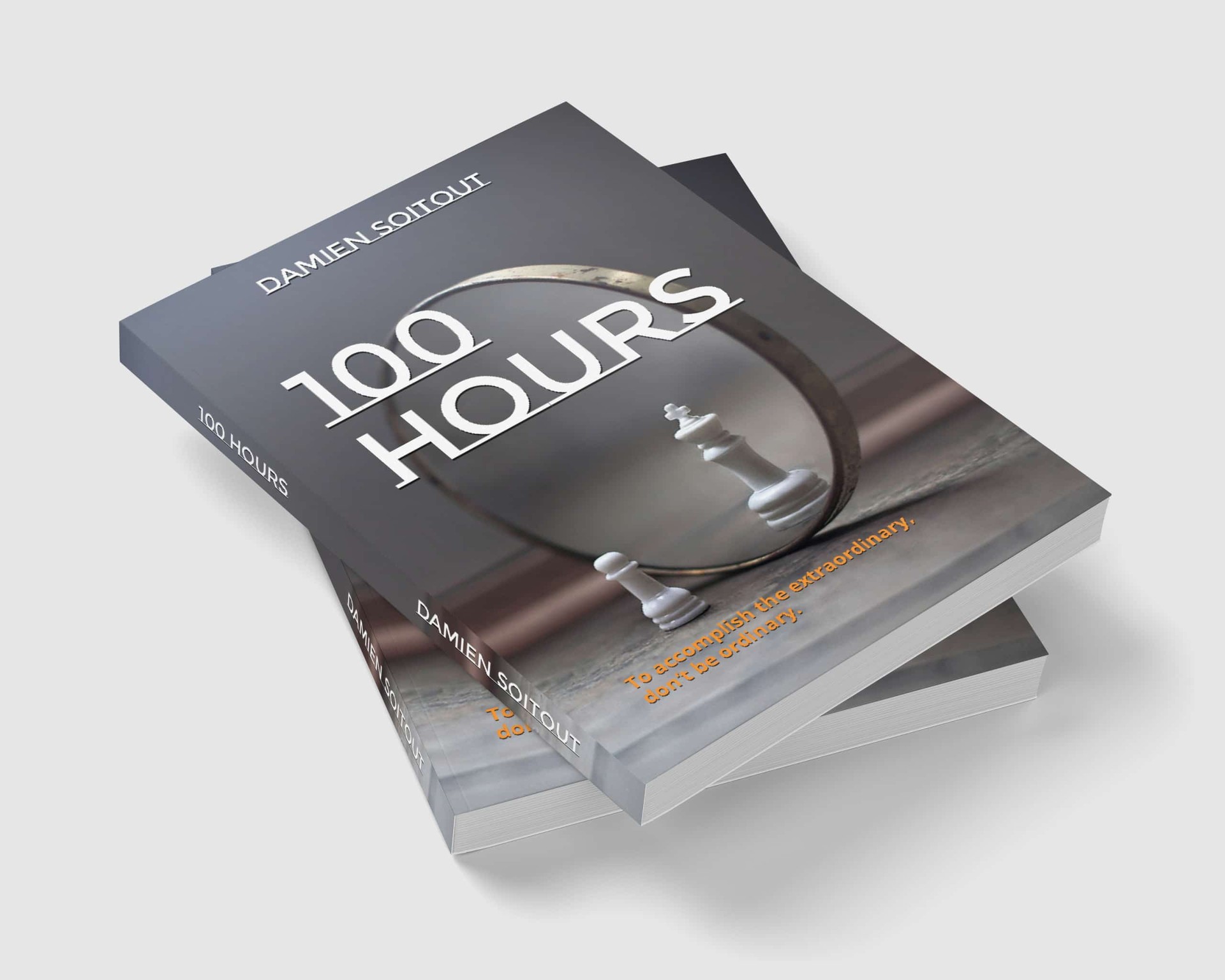
100 Hours is a set of tools, not a recipe for a life. Use the exercises: the map, the time tools, the questions. Do the work.
The English paperback is a set of tools. The cover will not do the exercises for you.
Readers will treat a new book as a formula. I wrote 100 Hours so the title would block that. The full title is 100 Hours to accomplish the extraordinary, don't be ordinary. The extraordinary in that line is not a prize I hand you for finishing the pages. It is whatever is left when you stop copying a life that is not yours. The book says, in the opening, that it is not another key to success and not a secret for how to make it. I meant that as a specification, not as modesty. A key implies a lock that is the same for every reader. There is no such lock. There are tools, and there are exercises, and there is research I cite so you can see I am not asking you to live on my adjectives.
The edition I am talking about is the English paperback. It is here: 100 Hours. Use that book as a set of instruments. Bring a pen. If you read it the way you read a brochure, you will finish with a mood and no change in Tuesday, and you will say the book did not work. Books of this kind do not work. Readers work, with the pages open.
10 reasons to start reading is the case for reading at all. Best books for entrepreneurs is a shelf, and this book can sit on it only if you treat it as work rather than as a charm. Learn to read faster is a skill that helps you get through other people's pages. It is a poor skill if you use it to skip the blanks you are supposed to fill. Start taking responsibility for your life is the posture the exercises assume. How to overcome failure is what you will need when an exercise shows you a gap and you want to close the book instead of the gap. I name those pieces so you can see the neighborhood. 100 Hours is the workshop. The neighborhood is not a substitute for doing the workshop.
It asks you to question, not to memorize a slogan. The introduction says the chapters should drive you to ask the right questions, not necessarily to answer the ones you arrived with. That is the opposite of a recipe. A recipe tells you the quantity and the time and promises a dish. This book tells you to look at childhood and education as the ground under the adult you are, to look at the bubble of beliefs you are inside, to look at the noise of media, to look at mental and physical health as part of any result you call success, and to notice the difference between a victim story and a leader's responsibility. None of those chapters ends in a life you can photocopy. They end in a question you have to answer in your own facts.
I cite other people's work on purpose, so the questions are not only mine. In the chapter on childhood and education I use a 2004 paper by Leon Feinstein and John Bynner, “The importance of cognitive development in middle childhood for adulthood socioeconomic status, mental health, and problem behavior,” published in Child Development. The abstract is public. The study looks at continuities and breaks in cognitive performance between ages 5 and 10, and at how those changes relate to adult income, education, work, and mental health. The analyses use about 11,200 people from the British cohort born in 1970, followed at 5, 10, 16, 26, and 30. The finding that matters for a reader is not a slogan about genius. It is that what happens in the middle of childhood can outweigh what was already visible at 5, and that circumstances shape that change. You can read the abstract yourself: Feinstein and Bynner, 2004. I put it in the book so a claim about development has a source. A recipe does not show its sources. A tool does.
Later chapters filter the market that sells success. Preachers of laws, certificates, cults of coaching, speakers who have not done the thing they describe. I am not innocent of teaching. I am insisting that you separate a person who has carried a result from a person who has rented a microphone. That filter is a tool. It will make you slower to buy the next formula, including mine, if you catch me offering one. Good. Use the filter on me.
The part people skip is the part that justifies the pages. Time, in the chapter on organizing yourself, is treated as a limited stock, not as a mood. One tool is time fragmentation, in four moves. First you capture: every task, goal, and open loop goes onto a sheet for the week, because a task that stays in your head adds stress and gets forgotten. Second you group: money, relationships, health, and the other areas of a life, so similar work sits together. Third you choose, inside each group, what is actually urgent in the week you are in, without abandoning an area because it is quiet. Fourth you name the change the goal requires, including the change that does not look like the goal. A health goal that ignores an overloaded afternoon will fail, and the tool forces you to write the afternoon down. That is not inspiration. It is a sort.
Beside it, the book uses levels of time. The level where you are doing the work that matches your aim. The level of ordinary accidents, which you cannot schedule away. The level of stress, which should not be allowed to become the week. The point of the levels is not a perfect pie chart. The point is to notice when the week has slipped into the level that only feels productive because it is loud. A recipe would give you a percentage and a promise. I give you the levels so you can see your own week. The seeing is the exercise.
The annexes are where I stop pretending that prose is enough. Annex 1 is a MAP, a massive action plan. You can draw it on a blank page. The columns are actions, result, purpose, and deadline. You fill it from the end. Purpose first: the life the plan is for. Result second: the concrete change that would serve that purpose. Actions third, each with a deadline. The example in the book is a person who wanted a better quality of life for a family and who needed a stronger job in order to get there. The actions were skills, help, and a network, each with a time. Your purpose will not be his. The direction of the filling-in is the tool. People who start with actions produce a busy week that serves no purpose they could say aloud. How to create a map, if you have used that shorter piece, is the same motion. The annex is the worksheet.
Annex 2 is an emotional inventory. You write what you feel, not the brand of person you prefer to be. An inventory is a count. It is not a confession for an audience. Annex 3 is launch costs, for a reader who is about to start something and would rather dream the start than price it. Price a life change before you invent the budget is the same instinct applied to a household. The annex applies it to a project. A cost you have not written down is a cost that will arrive as a surprise and then as a story about bad luck. Write it down while it is still a blank.
The money chapter does not hand you a return. It asks what your time is worth, and what you are treating as your worth, which are different questions that people collapse into one number. It asks you to look at simple and compound growth as mechanisms you should understand before you listen to anyone who wants to manage an hour of your future. Understanding the mechanism is not the same as a forecast. I do not put a forecast in the book, and I will not put one here. A tool that predicts your wealth from a chapter title is a recipe again, and it is a dishonest one.
How to read a month of spending is the household version of the same honesty. Before you use any larger money tool, you should be able to say what last month did. 100 Hours will not do that reading for you. It gives you the questions. You do the work.
Further reading: 100 Hours.