Damien Soitout
News from far away is still your job one month on. Distance does not make you a witness, and a month does not close the event.
The city is far. The news from farther away is still in the room.
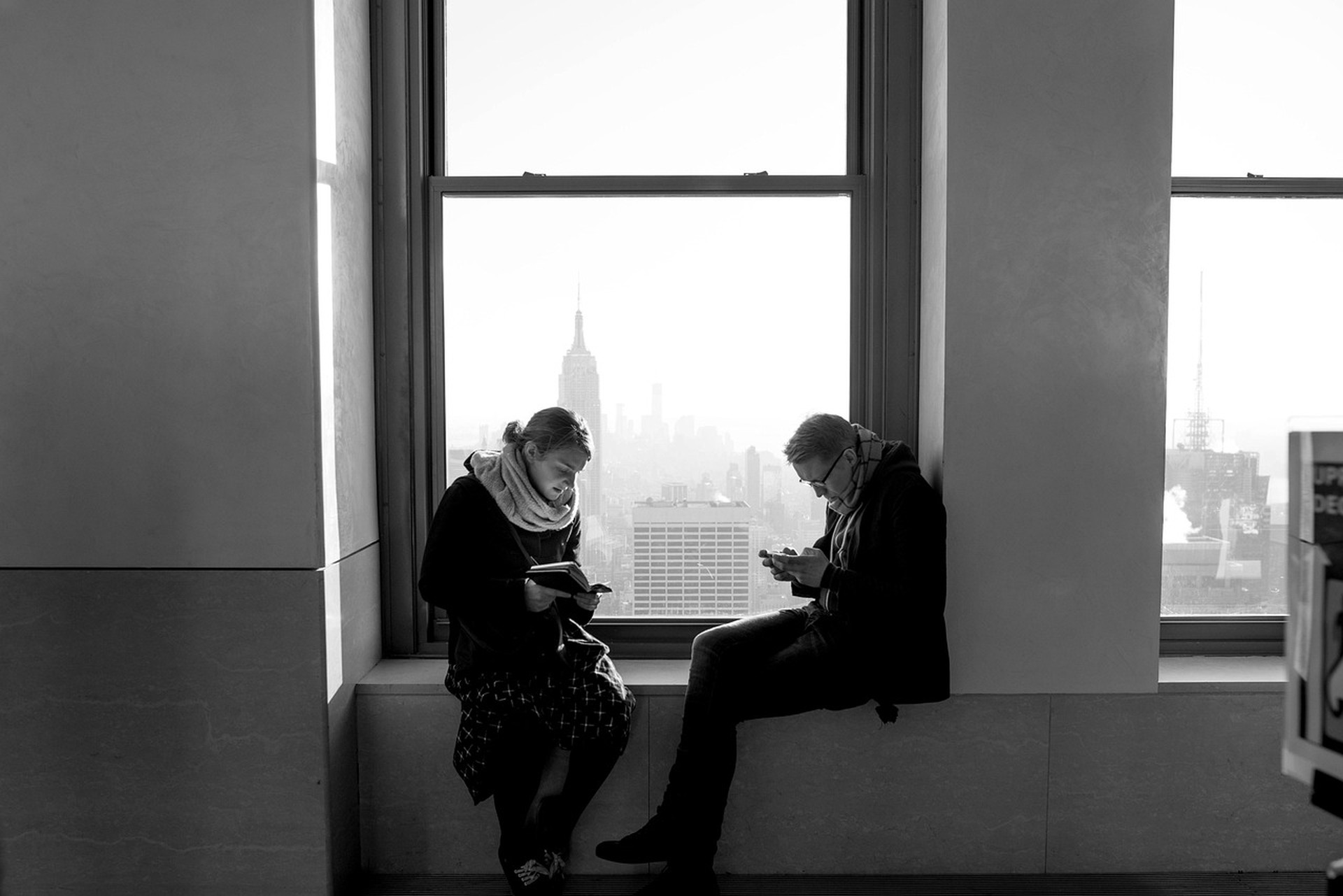
Distance does not close a news event, and it changes the reader's job. On 7 November 2023 it has been a month since 7 October. The attacks have not become a smaller fact because your feed found other pictures. They have become a fact you have to carry rather than a fact that carries you. In the first days, the news arrives as a blow. A month later it arrives as a choice, because habit is ready to file it. The two people in the picture are above a city, one with a book and one with a phone. Both distances are real: the city outside the glass, and the event that is farther than the city. How to carry the news from far away, one month on, is the skill of staying accurate about both.
The United Nations account from the day itself is still the record I point to, UN officials condemning the attacks. It is dated 7 October 2023. It reports the Secretary-General's condemnation of the attack by Hamas, the killing and wounding of civilians, people abducted from their homes, rockets fired, and the demand that civilians be protected and that the abducted be released. A month of later headlines does not edit that page. I was not there on the day, and I have not become a witness by reading for thirty days. The reader's job is not to grow a false proximity. It is to remember the record without wearing it as a personality.
In the first week, shock does a lot of the work. You do not decide to care. Care arrives as a disturbance in sleep, in temper, in the wish to keep checking. Grief, and the decision to keep building, was the right pairing then: do not stop the ordinary work as theatre, and do not turn the dead into a program. A month later the shock has faded for many people who were never in danger, and the fading is not wisdom. It is neurology and a busy life. Wisdom is what you do after the fading. You can notice that you flinch less and still refuse to talk as if the event had concluded because your flinch concluded. Wars and their grief do not end on a reader's nervous system. The news continues for the people in it. Your calm is not their calendar.
Distance also forbids a second error, and the second error gets worse with time. The error is performed closeness. A month of reading can feel like knowledge. It is not presence. You do not know the street. You do not know the room. You do not get to say “we” in a way that puts you inside a family that lost someone. Cruse, on understanding grief, is clear that grief depends on who is mourned, on the circumstances, and on the mourner's own perspective, and that there is no single correct way through it. Perspective includes being far. Far grief is allowed. It is quieter, more easily distracted, and more easily counterfeited. Counterfeit grief talks more than it helps. It needs an audience. Real attention at a distance can be silent, specific, and useful: you remember the fact, you do not invent detail, you do not demand that your friends perform a view, and you keep your own obligations.
Negativity spreads, and a month of unfiltered images is a machine for spreading it without adding understanding. Stopping a spiral of dark thought is not the same as stopping the news. The spiral is the loop in which you rehearse what you cannot change, lose sleep, and call the loss a contribution. The National Health Service, in its notes on stress, includes two lines that belong to a distant reader. Take control of what you can. Accept what you cannot change. You cannot change the event by another hour of pictures. You can change the hour: a walk, a meal, a piece of work, a donation you decided with a ceiling, a conversation that does not require a winner. Accepting what you cannot change is not approval. It is a refusal to pretend your anxiety is a lever.
Maintenance is less dramatic than shock, which is why people drop it. The job, one month on, has four parts. First, keep a source you can name. The UN piece is one. A newspaper you trust is another if you read it as a newspaper and not as a mood. Second, stop adding graphic detail you do not hold. A month of repetition has not made you an eyewitness. It has made you a person who has seen a lot of screens. Third, do not build a political program out of the distance. How companies adapt when the order of things shifts is a business question for firms that must operate. It is not a permission slip to turn a household into a faction. Fourth, do not drop the event because a month feels like a long time on the internet. A month is a short time in a grief. Cruse's point about different circumstances should make you slower to declare a chapter closed.
Staying steady in a bad situation and Resilience are maintenance skills, not smiles. Steady, a month later, looks like this. You can state what happened on 7 October without a thrill and without a shrug. You can sit with someone who is more affected than you are, because of family, faith, or history, and you can let their fear be larger than yours without competing. You can do Monday's work. The work that continues while the news does not is the operator's version of the same maintenance. A shop, a class, a clinic, a kitchen: they do not become serious by closing until the headlines agree. They become serious by staying competent while the headlines do not agree.
The National Institute of Mental Health describes stress as a response to an external cause, and it names traumatic events among those causes. A month later, if the response has become your whole day, if you avoid ordinary life, if sleep has not returned, the external cause has started an internal one. That is the time to talk to a person whose work is mental health, not to consume a more extreme video. NIMH's page on coping with traumatic events is a place to start that conversation in the American system, and immediate danger still belongs to emergency services and, in the United States, to 988. Carrying the news does not mean carrying it alone in a dark room. The WHO's account of depression says bereavement and other severe stresses raise the risk, and that connection, movement, and care are part of the answer. Connection, a month on, is a phone call to someone you actually know. It is not another public argument with a stranger who is also far away.
A distant reader uses the victims badly in a few familiar ways. As proof of a view the reader already held. As a reason to be cruel to a neighbor who had nothing to do with the attack. As content. As a test of whether friends say the sentence you prefer. Each of those uses is closer to consumption than to grief. Grief, even at a distance, makes you quieter about other people's pain and stricter about your own conduct. How firms adapt when the world is rearranging itself matters for anyone who employs people or buys from abroad. Adaptation is logistics, safety, and honesty with customers. It is not a flag in the window that does their grieving for them. People buy a feeling when the news is loud, and the feeling they should not be sold is proximity to a massacre.
If you give, a month later, give the way you can explain. A named organization, a purpose you read on their page, an amount you chose before you opened the app. The emotion of the scroll is a poor treasurer. The ceiling is what keeps a gift from being a performance. If you do not give, do not invent a speech about why your attention is a substitute. Attention without a fact is drifting. A fact without any consequence in your conduct is also thin, but the consequence may be as small as how you speak to the person next to you on the ledge. The book and the phone in the picture can coexist. The book is the work and the rest of a mind. The phone is the news. Neither should be asked to do the other's job for a whole month.
News from far away, one month on, is a weight you set down in the right room. The room is not the center of the story. The room is where you live. You keep the date, 7 October, attached to the record and not to a myth you improved. You keep the difference between a witness and a reader. You keep the ordinary work, the ordinary kindness, and the ordinary limit on what you will say. You let the event remain open, because a month has not closed it, and you let your own day remain a day, because collapsing your day into the event helps no one who was there.
That is the reader's job once the first shock has passed. It is less shareable than a slogan. It is more honest. The city outside the glass stays distant. The news from farther away stays news. You carry it without pretending you brought it home in your hands, and without setting it down just because your hands got tired.